Photographic Views of Meiji: A
Portrait of Old Japan |
| A strict policy of isolationism and
non-interference was instituted by Japan's Shogun Tokugawa in the
early 17th century, resulting in a medieval society locked in time.
It was not until the overthrow of the Shogun and his Samurai by
imperial forces in 1868 that Japan began to modernize. The
reinstatement of full power to the Imperial court and fourteen year
old Prince Mutsuhito initiated Japan's period of industrial growth.
The title "Meiji." which means enlightened peace, was given to the
new Emperor and his reign--a period which lasted forty-five years
until his death in 1912. |

Unknown; Geisha in Winter
c.1880 |
| The Meiji Restoration, as this period came to be
known, was the beginning of great change in Japan. With the return
of power to the young Emperor and the opening of Japan's seaports in
1854 to Commodore Perry and the American Navy, the Westernization of
the country began to take hold. Emperor Meiji encouraged his people
to study abroad and return with new ideas and technology. At the
same time he invited experts from Europe and America to visit his
country and bring with them important information which would assist
in Japan's progress. |

Beato; Fencing practice
c.1870 |
| The people of Japan, living in a society of extreme politeness
and formality which regarded life as a series of ceremonial acts,
showed little interest in Beato's black and white documentary
photographs of landscapes, village and trades-people. In an effort
to infuse photography with traditional Japanese aesthetics and to
gain a greater acceptance for his work, Beato, who was familiar with
both the long history of the Japanese colored woodblock prints and
the practice of adding color highlights to photographs in Europe,
decided to start hand coloring his albumen prints. Working with
Wirgman, an accomplished watercolorist, they began selling their
delicately tinted photographs. The Japanese people loved them at
once, feeling that they were truly Japanese, as was a silk kimono, a
painted fan, or a lacquer. They felt these prints were a perfect
souvenir for western travelers who desired to collect the cultural
and artistic objects of Japan.
|

Beato; Shinto Priest
c.1870

Beato; Street Cart
c.1870 |

Beato; Bettoes Resting
c.1870
|

Beato; Japanese Woman
c.1870
|

Beato; Geisha with Fan
c.1870
|
|
The popularity of these hand-colored images was so great that
Beato hired Japanese artisans who traditional painted woodblock
prints to subtly color his photographs. This time consuming process
could take a meticulous painter as long as twelve hours to complete
two or three prints. Later this tedious procedure was modified to a
production line where several colorists each worked on a particular
area of the photographs: one artist colored the faces, then passed
it along to another who tinted the clothing. And so on increasing
the output to as many as twenty or thirty prints a day. |

von Stillfried; Geisha
c.1880 |
| Another important photographer of Meiji
Japan was Austrian-born Baron Raimund von Stillfried. Von Stillfried
was a painter who brought his European cultural and artistic
background to photography. His work was psychological in character
and offered a deeper insight into the lives and social classes of
the people he photographed. The photograph he made, primarily in the
studio, often incorporated plain backgrounds and a minimal number of
props. In 1872 he opened a photography studio in competition with
Beato's firm, and in 1877 von Stillfried purchased Beato's studio,
along with his glass plate negatives and equipment.
|

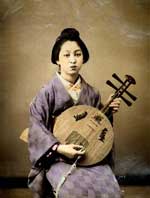
von Stillfried; Musician
c1880 |
| While in Japan, Baron von Stillfried
apprenticed Japanese assistants in his studio, many of whom later
went on to continue the photographic style established by the
Europeans. Kusakabe Kimbei was one of his special assistants who
had a great talent for the art of photography. He worked closely
with von Stillfried and in 1885 purchased most of his photographic
stock. He operated his own studio in Yokohama from 1885 to 1912,
where he produced portraits, scenes from daily life, and views of
Japan. Often Kimkei's photographs were like theatrical sets in
which he was the director. He selected the costumes, backgrounds
and props, then carefully positioned the "actor" to reflect the
polite social and religious ceremonies, rituals, and customs of the
Japanese people.
|

Kimbei; Shinto Priest
c.1885 |
| The photographs of Beato,
von Stillfried, Kimbei, and other photographers, many of who have
remained anonymous, resembled the Japanese woodblock prints in
content, style and coloring technique. Ukiyo-e prints, then the
most popular art of Japan, represented the superficial, earthly life
that passes quickly. The photographers of the Meiji period used the
subjects of the earlier printmakers as models for their photographs,
maintaining the Old World sensibilities of their Japanese customers
while at the same time satisfying the western demand for pictures of
classical Japan. They made portraits of Samurai warriors, street
musicians, and tattooed grooms, not as individual personalities, but
as stylized representations of social classes. They photographed
the serene beauty and landscape of the country showing Mt.Fuji, Lake
Hakone, simple teahouses and elaborate temples. The photographers
idealized old Japan and ignored its transformation from an insular,
medieval country to a modern land. This one -sided photographic
view gave outsiders the misleading impression that Japan was a
quaint, archaic nation well into the twentieth century.
|

Kimbei; Washing hands
c.1885 |

Kimbei; Girls showing Obi
c. 1885 |
Kimbei; Geisha resting
c.1885
|
Kimbei; Enoshima Island
c.1890 |
Kimbei; Mt. Fujiyama
c.1885 |
|
The stylized genre photographs made in Japan during the later
part of the nineteenth century are in some ways similar to
ethnographic studies made of other "exotic" people; Chinese,
Africans, Native Americans and other nationalities were all
photographed as native "types" showing their own special features.
However, the theatrical stage set-ups, use of props, and delicate
hand tinting of the prints from the Meiji period give these
photographs a distinctive character and elegance all their own,
truly unique to Japan.
Richard W. Gadd |

Unknown; Performers
c.1880 |
Richard Gadd is the Director of
the The Monterey Museum of
Art, Monterey, California.
The photographs are from his personal
collection. |
|